KPop Demon HuntersNetflix AnimationKorean MythologyArt Books
"KPop Demon Hunters" Disguised Korean Shamanism as Pop Glitter — Its Art Book Proves How Deep the Roots Go
500 pieces of concept art and holographic page edges pack a 144-page hardcover that unpacks the manhwa lineage, K-pop idol references, and mythological framework behind Netflix's Oscar-winning animated phenomenon, as both original directors return for a sequel and dolls, comics, and a boxed set arrive in November.
Source material: variety.com
500 Pieces of Concept Art, One Oversized Tome
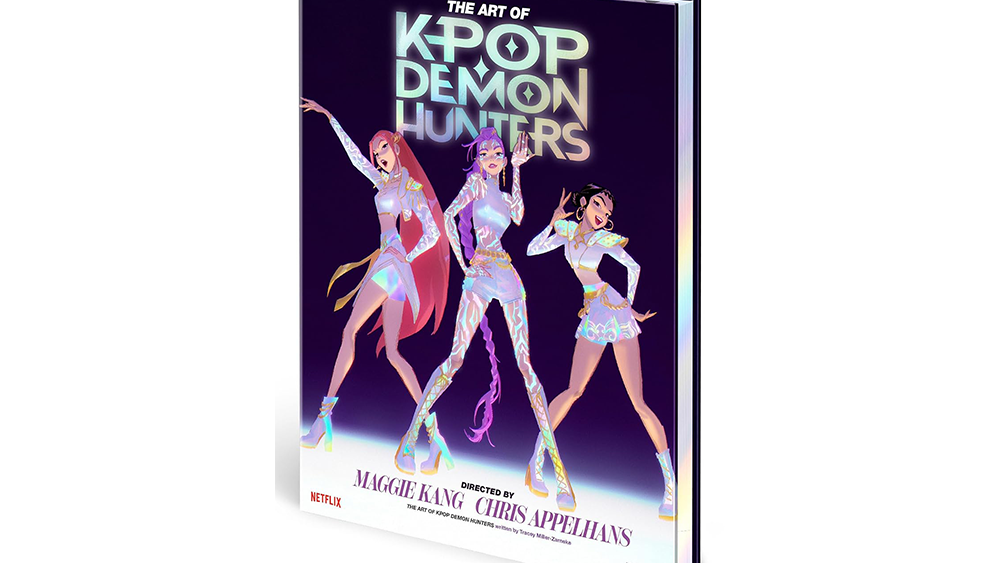
Written by Tracey Miller-Zarneke, The Art of KPop Demon Hunters: Platinum Edition lands September 8 as a 144-page deluxe hardcover. Inside are more than 500 pieces of concept art spanning early character studies, works in progress, and final designs pulled from the Netflix film's production pipeline. Commentary from the creative team accompanies the visuals, explaining the reasoning behind each design pivot. The package is deliberately oversized — a format choice that lets the art breathe across full spreads rather than getting squeezed into a standard coffee-table layout. For anyone who paused mid-scene to admire the intricate costume work or the Saja Boys' transformation sequences, this is the chance to see how those moments evolved from rough sketches into what ended up on screen.
Holographic Page Edges That Channel the Honmoon
The book's most distinctive production detail is its holographic foil page edges, designed to physically evoke the Honmoon — the supernatural barrier that the girl group Huntr/x protects throughout the film. It's a tactile callback to one of the story's central concepts, turning a design flourish into a narrative echo. When the book sits on a shelf, the shimmering edges hint at the boundary between the human and demonic worlds that drives the plot. Publishers rarely invest in holographic foil for interior page edges; it's a cost-intensive finish more commonly seen on slipcases or cover treatments. Its presence here signals Netflix's commitment to positioning KPop Demon Hunters as a prestige animated property, not just a streaming hit. The effect is subtle in low light and vivid under a reading lamp, which mirrors how the Honmoon itself operates in the film — invisible until the moment it matters.
Korean Shamanism as Visual Language
Among the cultural references the book's commentary explores is Korean shamanism, specifically its ritual imagery and spiritual symbolism. Directors Maggie Kang and Chris Appelhans drew on shamanistic motifs to design the film's demon-hunting sequences, grounding supernatural action in a tradition that predates modern Korea by centuries. The art book traces how mudang — Korean shamanic practitioners — influenced character poses, talisman designs, and the visual grammar of the Honmoon barrier itself. It's a deliberate choice to anchor a candy-colored animated film in authentic folk practice rather than generic fantasy tropes. For Western audiences unfamiliar with gut (shamanic rites), the book functions as a quiet education, showing reference photos alongside the final animation frames. For Korean viewers, it's a recognition of cultural touchstones that often get flattened or omitted in Hollywood animation.
Manhwa and Anime Lineage, Made Explicit
The art book documents how Korean manhwa and Japanese anime shaped the film's visual DNA — from panel composition to character proportions to the way action sequences break across implied gutters. Early character studies among the more than 500 pieces of art collected in the volume render Rumi, Mira and Zoey in styles ranging from shōjo softness to webtoon sharpness before the production settled on its final look. Specific manhwa titles aren't named in the available materials, but the influence is legible in the exaggerated facial expressions during comedic beats and the dramatic speed lines that accompany the Saja Boys' demonic reveals. The commentary positions the film as a bridge between Korean and Japanese visual storytelling traditions, acknowledging that manhwa and anime share a common lineage while insisting on their distinct qualities. It's a rare instance of a major animated feature openly crediting comic-book traditions rather than pretending its style emerged from nowhere.
Real K-Pop Idol Groups as Reference Points
Huntr/x's high-gloss stage costumes and synchronized choreography didn't materialize from thin air. The art book's commentary details how real-life K-pop idol groups served as direct reference points for the fictional girl group's visual identity — from fabric textures to styling choices to the way light catches sequins during concert sequences. The Saja Boys received the same treatment in reverse: their public-facing boy-band polish is modeled on industry archetypes, while their demonic true forms subvert those same aesthetics. Concept art shows early iterations where the contrast between idol glamour and supernatural menace was either too subtle or too jarring, and the commentary walks through how the design team calibrated each look. The result is a film where K-pop industry satire and demon-hunting action share the same visual vocabulary, and the book makes that calibration visible.
Two Academy Awards and a Record-Breaking Run
Since its June 2025 premiere on Netflix, KPop Demon Hunters has accumulated a track record that reshapes expectations for animated streaming releases. It became the platform's most-watched film of all time — a milestone that covers both animated and live-action titles in Netflix's catalog. The Academy of Motion Picture Arts and Sciences recognized it with Oscars for both Best Animated Feature and Best Original Song, a double win that few animated films achieve in a single ceremony. Those awards placed the film alongside a short list of animated features that have dominated both the streaming and awards landscapes simultaneously. The art book arrives in the wake of that momentum, positioned as both a collector's object and a production document. For the creative team, the accolades validate the years-long process of building a world dense enough to reward repeat viewing.
A Sequel With Both Original Directors Returning
Netflix has officially greenlit a sequel to KPop Demon Hunters, with Maggie Kang and Chris Appelhans both returning to direct. The announcement came after the film's record-breaking viewership and dual Oscar wins made continuation a foregone conclusion, but the confirmation of both directors signals continuity rather than franchise expansion at the expense of creative vision. Kang and Appelhans built the original film's world from the ground up — the Honmoon mythology, the Huntr/x dynamics, the Saja Boys' demonic threat — and their return suggests the sequel will deepen that foundation rather than reboot it. No release date has been announced. The art book's documentation of the first film's development process may offer clues about where the story heads next; concept art that didn't make the final cut often contains seeds of future directions.
Dolls, Comics, and a Screen-Comic Boxed Set Arriving in November
Beyond the art book, Netflix is building a merchandise ecosystem around KPop Demon Hunters that extends well past streaming. The current lineup includes dolls, apparel, footwear, comics, and collectibles — a range that mirrors the franchise strategy typically reserved for theatrical animated properties. The most distinctive addition is an official screen-comic boxed set scheduled for November, which adapts the film's story into a format that bridges animation and print. The art book sits at the premium end of that spectrum, targeting collectors and animation enthusiasts rather than casual fans. Together, the releases represent Netflix's most aggressive push to date to build an animated franchise with physical retail presence. The question is whether a streaming-first property can sustain merchandise demand without theatrical runs driving foot traffic — and the KPop Demon Hunters rollout is the test case.