My Brilliant CareerMiles FranklinSybylla MelvynPhilippa Northeast
Sybylla Melvyn Carries Miles Franklin's Unmistakable Fingerprints
Her paid writing, her principles, her Augusta and suffragette connections, her changing image, and an actress who studied her journals—all leave marks on Netflix's heroine.
Source material: thecinemaholic.com

A Mirror of the Author
Sybylla Melvyn is not a real writer, but she is a close fictional reflection of Miles Franklin, the Australian author who published the novel My Brilliant Career in 1901 when she was 21. The character and her story carry autobiographical elements, though Franklin deliberately shaped them from a highly fictionalized and somewhat satirical perspective. Sybylla's hunger for a writing career echoes Franklin's own ambition at that age. The author's life took similar turns: she was born in her grandmother's house in the late 19th century and first educated by a private tutor. None of that makes Sybylla a faithful self-portrait; Franklin made her protagonist the rebellious, headstrong person she wished she could be. The result is a heroine who feels real precisely because she is an idealized, exaggerated version of her creator.
From Private Tutor to Dairy Farm
Franklin's early years supplied the novel with its social contrasts. The family's financial collapse forced them onto a small dairy farm, where formal education became a secondary concern, yet her love for books and stories endured. That background is dramatized through Sybylla's own removal from poverty to her grandmother's wealthy estate. Franklin was 19 when she began writing the story and 21 when it was published in 1901, so the shift from a private tutor's lessons to the farm's physical labor was both recent and vivid. The tutor's world had promised intellectual pursuits; the farm demanded sheer toil. That clash between the life of the mind and the demands of survival infused Sybylla's hunger for a writing career. In practice, the novel's class tensions come from a firsthand account: the grand house and the backbreaking work are not just settings but lived realities, giving the reader a concrete sense of the economic divide Sybylla navigates.
A Published Author Who Earned a Wage
Franklin published several novels and held a paying job, making her own money—something Sybylla explicitly craves. That outcome stands in contrast to the marriage plot thrust at the fictional heroine. Franklin remained unmarried all her life, as Sybylla plans to do. She lived out the dream she had at 19, turning her ambition into published work and financial independence. A woman could support herself without a husband, directly countering the era's expectation that marriage was the only respectable future. Yet in the novel, the tone is less triumphant than the Netflix adaptation; the title My Brilliant Career is partly ironic because the story ends on a somber note. Still, Franklin's real career gave the fiction its grounding. She had the agency and independence that Sybylla is still fighting for when the book closes, and that contrast between the author's later success and the heroine's uncertain future sharpens the novel's critique of a society that denied women such opportunities.
A Matter of Principle
Sybylla Melvyn repeatedly refuses marriage proposals throughout My Brilliant Career, and her refusal is a matter of principle. She sees marriage as a direct threat to her writing ambitions, a trap that would end her hopes of a brilliant career. This stance drives her to seek an independent life, even when it means defying her family's expectations. The narrative uses her resistance to expose the limited options available to women who wanted more than a domestic role. Franklin herself was averse to marriage and remained unmarried all her life, so Sybylla's position echoes the author's personal conviction. The novel does not reward Sybylla with a happy compromise; it ends on a somber note, suggesting that the cost of her independence is real and that society's barriers remain. Indeed, the title My Brilliant Career carries an ironic weight because the heroine's refusal does not clear a path to the career she craves; it leaves her confronting the steep odds against any woman seeking that kind of life. By making Sybylla stand firm against proposals, Franklin turns a personal choice into a political statement about women's autonomy and the narrow definitions of success.
Augusta and the Suffragette Thread
Beyond Sybylla's personal journey, Franklin used supporting characters to expose structural injustices. The character Augusta, who heavily influences Sybylla, becomes a vehicle for the suffragette movement's importance. Through Augusta, Franklin shows how an older woman's guidance could open a younger woman's eyes to the necessity of political reform. Franklin also turned the spotlight on concrete inequalities: women were denied property ownership and refused jobs even when they were highly qualified. These are not abstract complaints but legal and social facts of the era—options that were simply closed to women regardless of merit. What actually happens in such a world is that a talented woman like Sybylla has her ambition funneled toward marriage, because no other avenue leads to security. The suffragette movement, as represented by Augusta, offers a collective response to that predicament, yet the novel does not pretend that awareness alone solves it. By embedding these barriers into the story, Franklin made My Brilliant Career more than a coming-of-age tale; the title's irony deepens because a brilliant career was not something society was designed to let women have.
A Visual Transformation
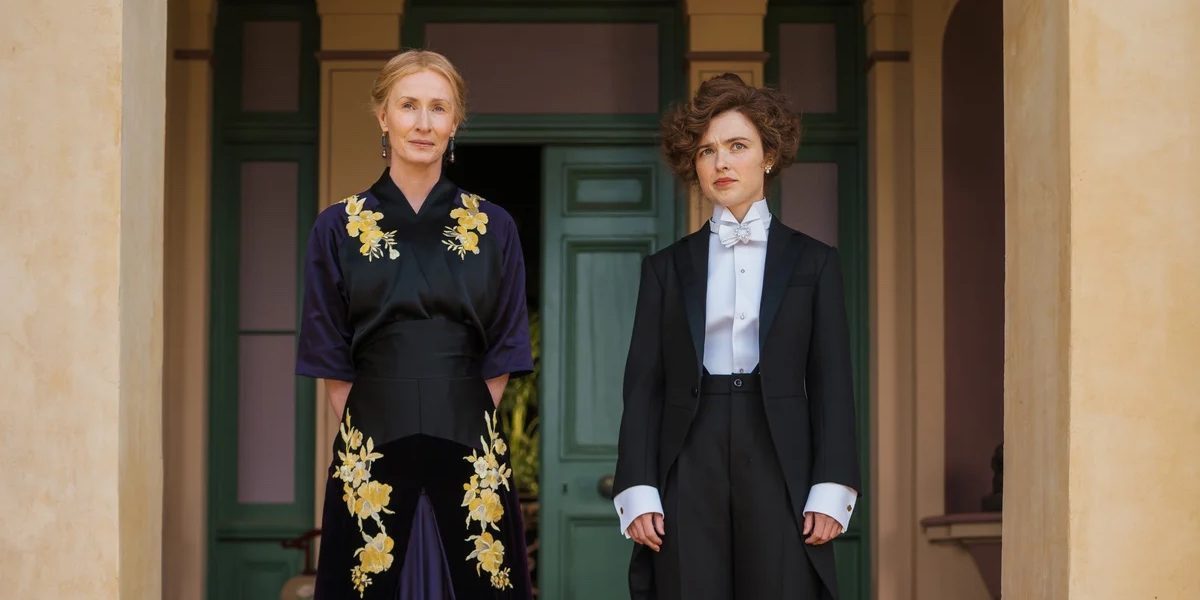
Sybylla's appearance in the series is a deliberate visual arc that mirrors her internal growth. At the start, her hair and skin appear untamed, and her dresses are plainly humble, reflecting her poverty and unpolished nature. As she moves into her grandmother's wealthy household, a makeover transforms her: she is dressed in more formal clothes to fit polite society. But that refinement is not a surrender. Over the season, she learns to assert herself through her wardrobe, choosing pieces that carry her feminist touch while still appearing refined. The costume and makeup departments used these shifts to show Sybylla becoming more confident in her own identity, not merely conforming to expectations. Her clothes become a statement of who she is—a woman who can navigate high society without losing her principles.
An Actress Who Read the Author's Journals
Philippa Northeast, who plays Sybylla, came to the role with a preexisting bond to the book. Her mother introduced her to it at a young age, and she reread it as a teenager and again as an adult. Each reading at a different stage of her life shed light on something new, bringing her closer to Sybylla. For the Netflix series, she went deeper, pulling the archives of the State Library of New South Wales and reading Miles Franklin's actual journals. Those diaries gave Northeast a direct line to the author's vision for Sybylla, which shaped her performance. At the start of her career, she saw parallels between herself and Sybylla—both wished to live on their own terms while balancing society's expectations. She was moved by Franklin's own journey and became determined to honor it on screen. The journals revealed the personal struggles behind the novel, deepening Northeast's understanding of Sybylla's fierce ambition. That research informed everything from her line readings to how she moved, and it clearly shows in the finished series.